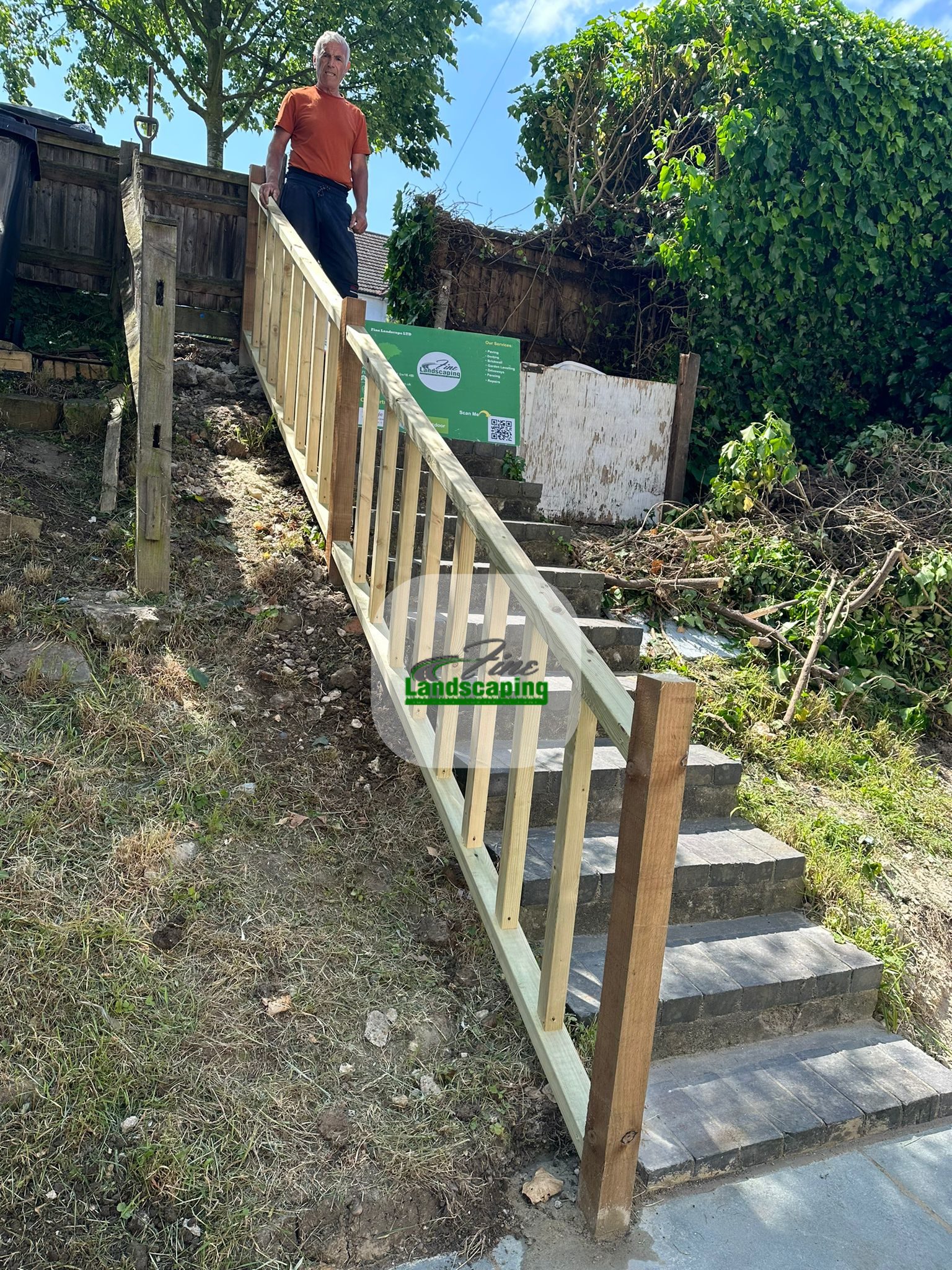
We build garden steps across South London from our base in Norbury SW16: concrete steps clad in porcelain or Indian sandstone, floating steps with bullnose edges, brick steps, composite deck steps and handrails for steps already there. Every job here is documented, from a wooden rail on Streatham steps for just over £1,150 to four floating sandstone steps and a patio in Herne Hill for £10,000.
A step takes a heavier, sharper load than flat paving, because every footfall lands near its front edge. That is why most of the steps on this page have a concrete core. The old steps are broken out, whether they are timber, sleepers, tired concrete or rubble, and a solid core is formed in their place: cast on a concrete base, as in Crystal Palace, or reinforced with mesh, as for the floating steps in Herne Hill. Only once that core has set does any cladding go on.
Cladding is the part you see and walk on. It is usually the same stone or porcelain as the patio, so the steps and paving read as one: light grey porcelain in Crystal Palace, white porcelain in Sutton, mint Indian sandstone in Herne Hill and Autumn Indian sandstone in Orpington. Treads can have a bullnose, a rounded front edge that is kinder to shins and bare feet, like the London Stone bullnose porcelain in Shortlands. Risers are clad to match and the joints are pointed.
Where the ground changes level there is usually more than one answer. Four steps link two porcelain terraces in Norbury; a single full-width step finishes a raised patio in Bromley; five clad steps and a ramp for easy access were built in Orpington. On a raised deck the steps are framed and clad in the same composite, as in Greenwich. And where steps are sound but steep, a handrail can be the whole job. Our own team builds every step, and the work carries our 10-year workmanship guarantee.
Each project has its own case study with photos and a price, plus the time on site where it was recorded.
BeforeAfter
The steps from the back doors · drag to compare
BeforeAfter
Looking back from the garden · drag to compare
Featured project · Herne Hill SE24 · April 2026
Floating mint sandstone steps and patio in Herne Hill
Outside the large glazed doors of this Herne Hill house, the old steps were broken out and removed. A 1m platform and four floating steps were built and reinforced with mesh, ready for cladding, then fully clad in mint Indian sandstone with bullnose edges all around. At the foot of the steps a Type 1 sub-base was compacted and 20m² of the same sandstone was laid as a patio. £10,000 including VAT.
On a steep garden with access only through the house, concrete was pumped in for a base, new steps and a shed base, the steps were clad in London Stone bullnose porcelain and a 25m² grey 60 × 90cm porcelain patio was laid with a concrete edge, in one week for £9,250 including VAT.
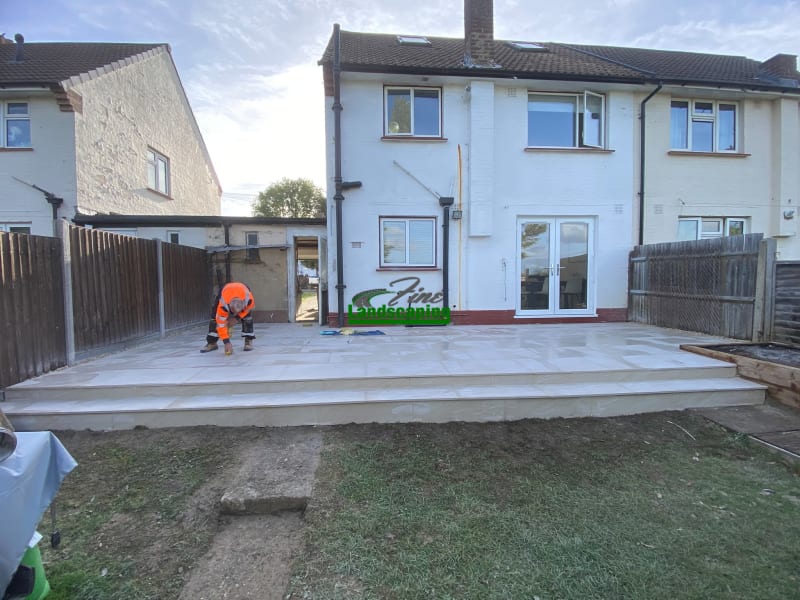
A full dig-out and around 50m² of 60x90 porcelain on two levels, with four concrete steps clad in porcelain, supplied and fitted in one week for £12,000 including VAT.
A larger patio in beige 600 × 900 mm porcelain on a new concrete base, with porcelain-clad steps, re-routed pipework and the manhole reset, completed in 10–14 days for £12,000–£15,000.
An old raised deck and curved steps removed through the house, the ground taken back to soil, then around 20m² of white porcelain, four porcelain-clad steps moved to the side and around 35m² of new turf, in ten days for £15,320 including VAT.
A new red-brown block paving driveway, Autumn Indian sandstone down the side and across the back, five clad steps, a ramp, a curved path beside new turf, a sleeper bed, eco drains and three recessed manhole covers, with over 100 tonnes of soil removed, in four weeks for around £45,000 including VAT.
A garden stripped back and rebuilt in two weeks: a rendered retaining wall, around 20m² of curved beige porcelain, a 4m x 4m composite deck, steps, new turf and circular flower beds.
Concrete cores, cladding and a new handrail, photographed on documented jobs. Click any photo to enlarge it; the place name links to that job's case study.
Concrete is the core on most of these jobs; the finish follows the patio, the house and how the steps will be used.
01
Porcelain-clad steps
Matches a porcelain patio
Concrete steps with porcelain on the treads and risers, in the same slab as the patio. Four light grey steps rise through the planting in Crystal Palace, four steps link two terraces in Norbury, and in Sutton four steps were rebuilt to the side and clad in white porcelain.
A bullnose tread has a rounded front edge. Floating steps overhang their risers so they seem to hover, like the four mint sandstone steps in Herne Hill. In Shortlands, pumped concrete steps were clad in London Stone porcelain with bullnose edges.
Indian sandstone suits a sandstone patio and an older house. Five steps in Orpington are fully clad in Autumn Indian sandstone, and in Wimbledon the steps at the doors were paved in sandstone.
Brick steps suit gardens with brick walls. In New Malden large brick walls and steps went up together; in Wimbledon Park two new steps were paved and topped with coping stones; in South Norwood two brick steps finish the lower end of the garden.
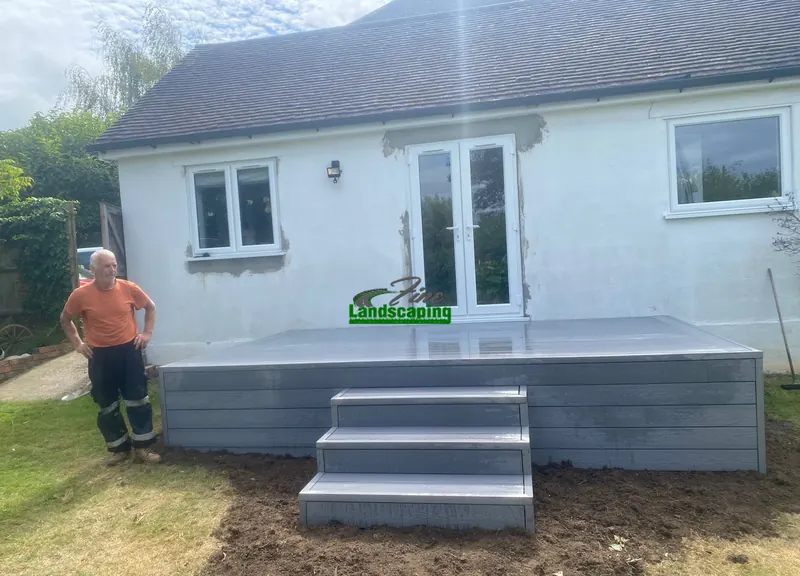
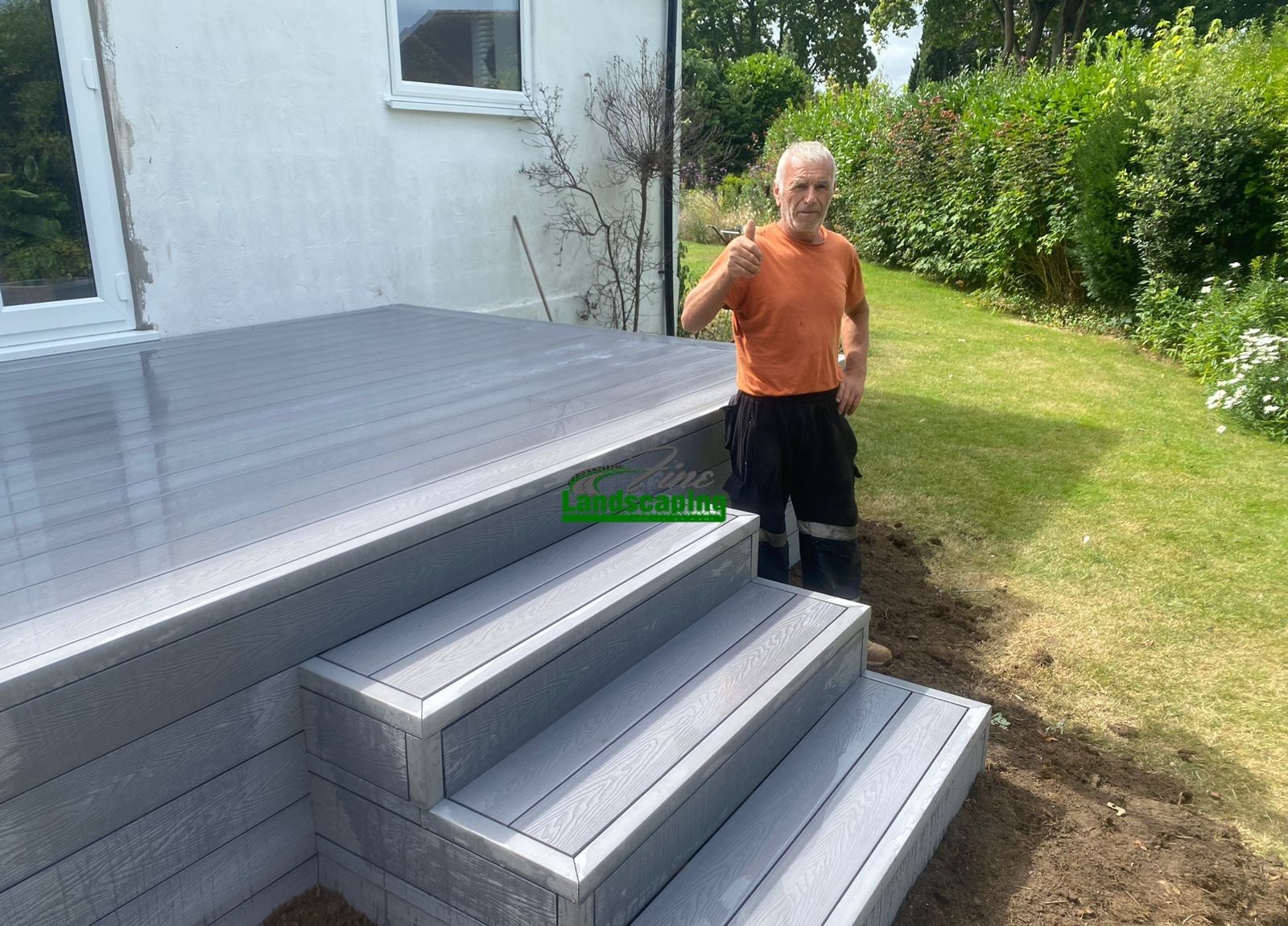
On a raised deck the steps are part of the structure. In Greenwich a raised timber frame was built outside the back doors, including the frame for three steps, then the deck and steps were clad all round in grey composite, in three days.
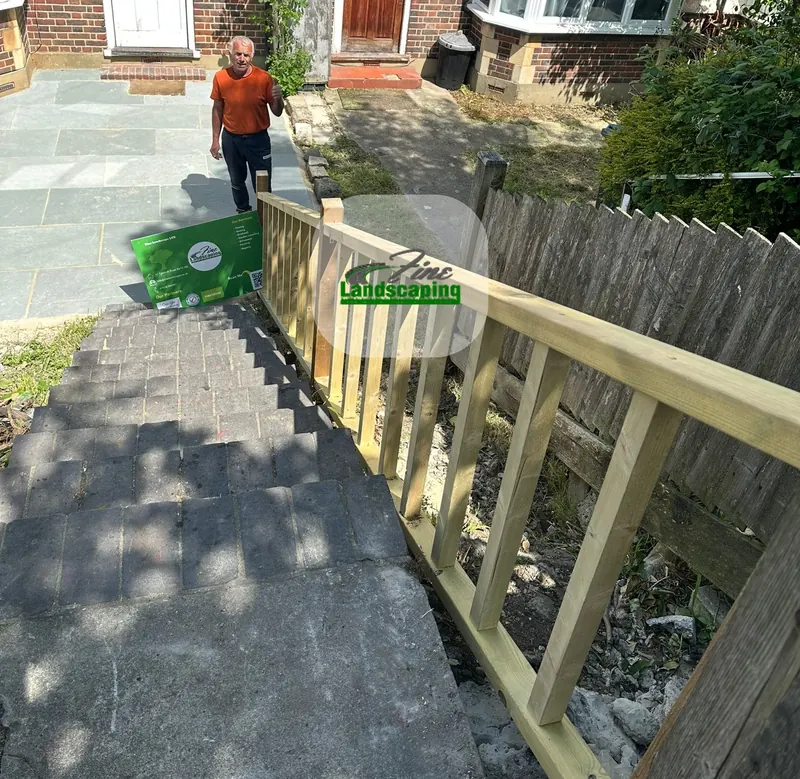
Where existing steps are solid but steep, a rail may be all they need. In Streatham wooden posts and rails were put in along the side of the steps to the client's specification, in one day for just over £1,150.
Even risers: the measurement that stops people tripping
People trip on steps that are uneven far more than on steps that are steep. The eye reads the first step and the feet repeat it, so every riser in a flight should be the same height and every tread the same depth. That has to be worked out before the concrete goes in: the total change in level is measured, divided into equal risers, and the formwork set to those heights, allowing for the cladding and its bed on top. In Bromley the timber formwork was set to the finished height and line of the step before any concrete was poured.
How we build it
How we build garden steps
Four stages, from a single step to a full flight.
01
Survey and quote
We measure the change in level, look at what the steps must connect, check for drains and pipes nearby, then send a written quote.
02
Break out and form
Old steps, sleepers and rubble are removed, then the flight is set out in equal risers and formed in concrete, with mesh where the steps float.
03
Clad
Once the concrete has set, the treads and risers are clad in porcelain, sandstone or composite, with bullnose edges where they were chosen.
04
Point, clean and hand over
The joints are pointed, the steps and the paving around them are cleaned down, and the waste is taken away before handover.
A complete quote, not a guess
What do garden steps cost?
Steps are rarely priced on their own, because the levels they join usually change at the same time. The smallest jobs in the table are the wooden rail in Streatham at just over £1,150 and the raised composite deck with three steps in Greenwich at £5,600. Four porcelain steps with a patio and fence came to £7,000 in Crystal Palace, the Herne Hill floating steps and patio to £10,000, and the two-level Norbury patio with four steps to £12,000. Height, the number of risers and the cladding set the price.
How far the ground changes level, and so how many risers are needed.
Breaking out
Removing old timber, sleeper or concrete steps and the rubble behind them.
Concrete and access
Forming the core, and a truck and pump if everything must go through the house.
Cladding
Porcelain, sandstone, bullnose pieces or composite, and the cutting involved.
Rails and extras
Handrails, ramps and the patio or lawn at the top and bottom.
Compare like for like. Check that a quote for steps says what the core is made of, how many risers there will be, what the treads and risers are clad in and whether bullnose edges are included. Our written quotes list each part of the job separately.
Prices as shown on each case study. Every garden is different, so your price is fixed in a written quote after a free site survey.
7 local pages
Garden steps by town
Pages about garden steps in seven of the towns we cover, grouped by council area and ordered by distance from Norbury. The bold links are full local guides with nearby jobs.
It depends on the height to be climbed. The total rise is divided into equal steps of a comfortable height, so a small change needs only one full-width step, as at the edge of the raised Bromley patio, while a bigger one takes four, as in Crystal Palace and Norbury, or five, as in Orpington.
Should steps be porcelain or sandstone?
Match the patio, as a rule. Porcelain gives crisp edges and an even colour, as on the Crystal Palace and Sutton steps; sandstone varies from piece to piece and softens the look, like the mint sandstone in Herne Hill and the Autumn sandstone in Orpington. Both can have bullnose edges and both sit on a concrete core.
Can old steps be clad instead of rebuilt?
Sometimes. If the existing steps are solid and the heights are even, they can be clad in new paving, as with the back-door step in Wimbledon and the back step in Hackbridge. If they are cracked, loose or uneven, breaking them out and starting again is the safer job.
How are steps built on a raised deck?
As part of the deck frame. In Greenwich the frame for three steps was built with the raised timber frame outside the back doors, and the deck and steps were then clad all round in grey composite. Deck steps are framed in timber rather than cast in concrete, because the deck carries them.
Are steps or a ramp better on a sloping garden?
Often both. Steps take up less room for the height they climb; a ramp is easier for buggies, bikes, wheelbarrows and anyone unsteady on their feet. In Orpington five clad sandstone steps link the lower patio to the garden, and the very back of the garden was paved with a ramp for easy access.
Can steps be moved to a different place?
Yes, when the patio is rebuilt at the same time. In Sutton the old deck, railings and curved concrete steps were all taken out, and four new concrete steps were built to the side of the new patio and clad in the same white porcelain.
How long does a job with new steps take?
A handrail took one day in Streatham, and the composite deck with three steps took three days in Greenwich. Where steps come with a new patio, the jobs here took one to two weeks: a week in Shortlands and Norbury, ten days in Sutton and two weeks in South Norwood. The larger rebuilds in the table took three to five weeks.
Is a bullnose edge worth having?
It comes down to looks and feel. A bullnose tread has a rounded front edge, so there is no sharp corner to knock and the step looks finished from the side. The Herne Hill and Shortlands steps have bullnose edges. If you want them, check that the quote says so.
Are your garden steps guaranteed?
Yes. Every step is built by our own team, we are fully insured, and the workmanship carries our 10-year guarantee. The full terms are on our warranty and guarantees page.
Free site survey
Planning new garden steps?
Tell us roughly how big the change in level is and what the steps will connect. We will book a free site survey and send a written quote.