A tiled path is the first thing anyone sees of the house.
We lay Victorian tile front paths in the pattern of your choice, from our base in Norbury SW16. Below are the tiled paths we have documented, from a £3,820 path on a reinforced concrete base with rope edging in Acton to whole front gardens in Clapham and Putney, plus other front gardens we have built across South London.
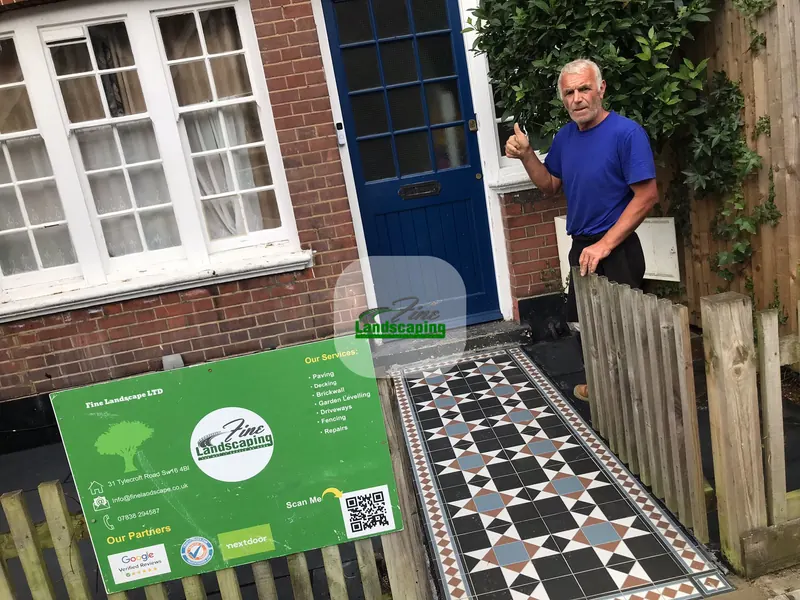
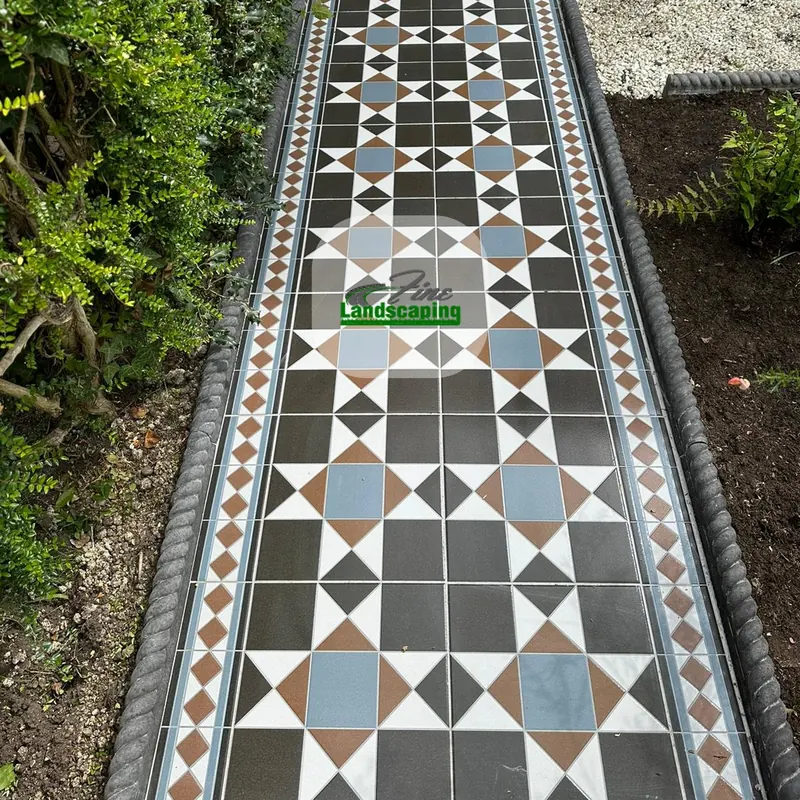
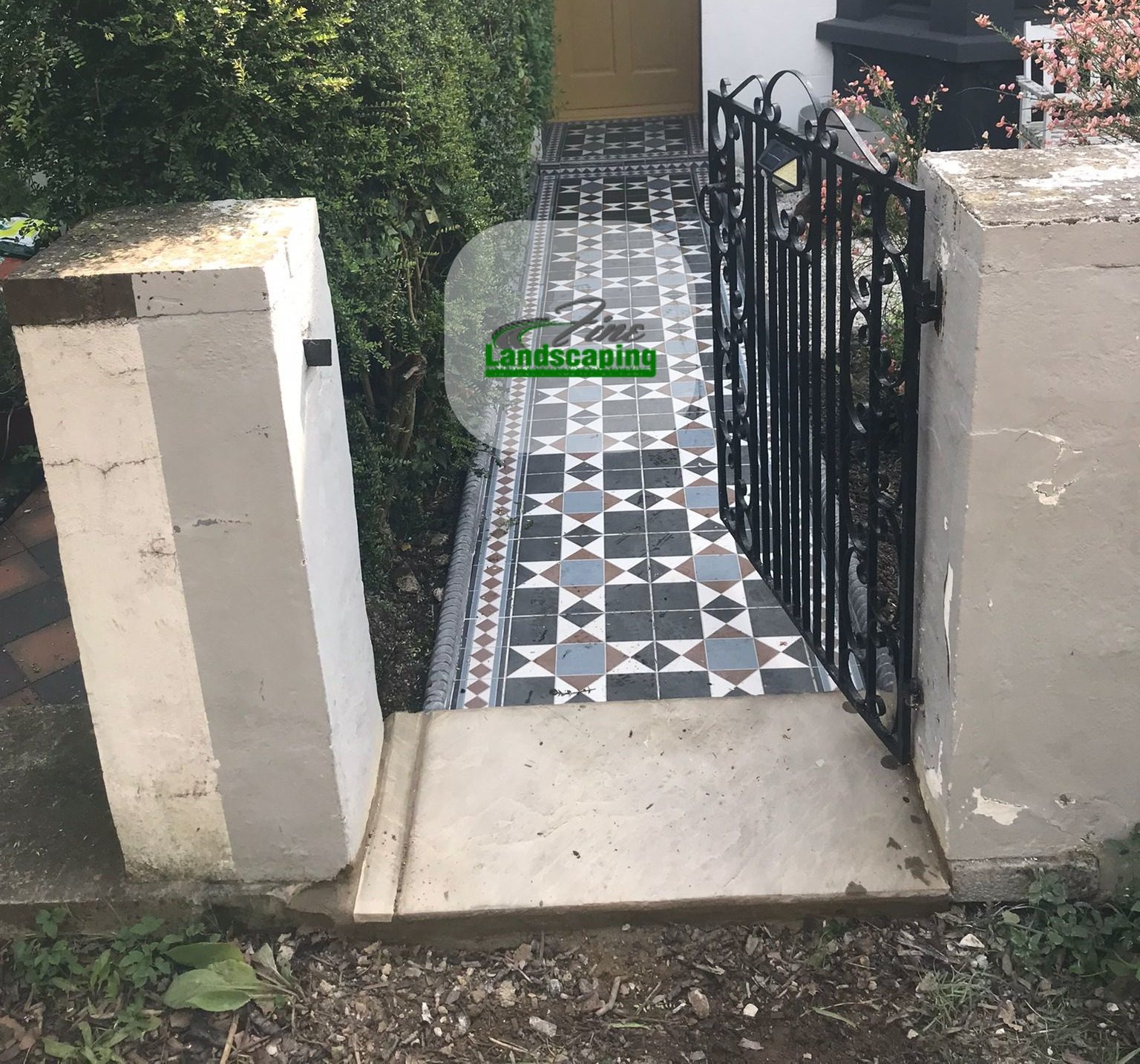
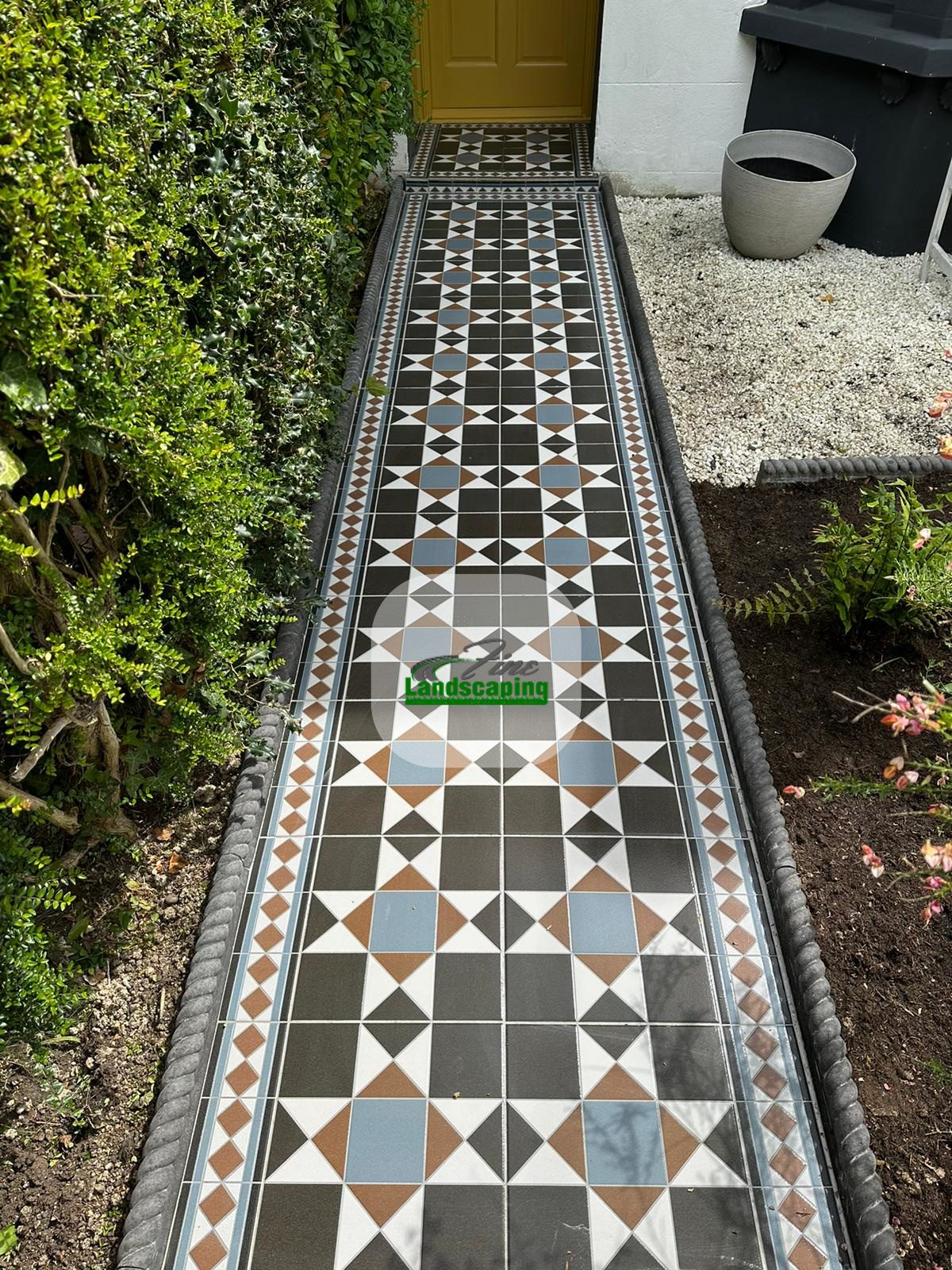
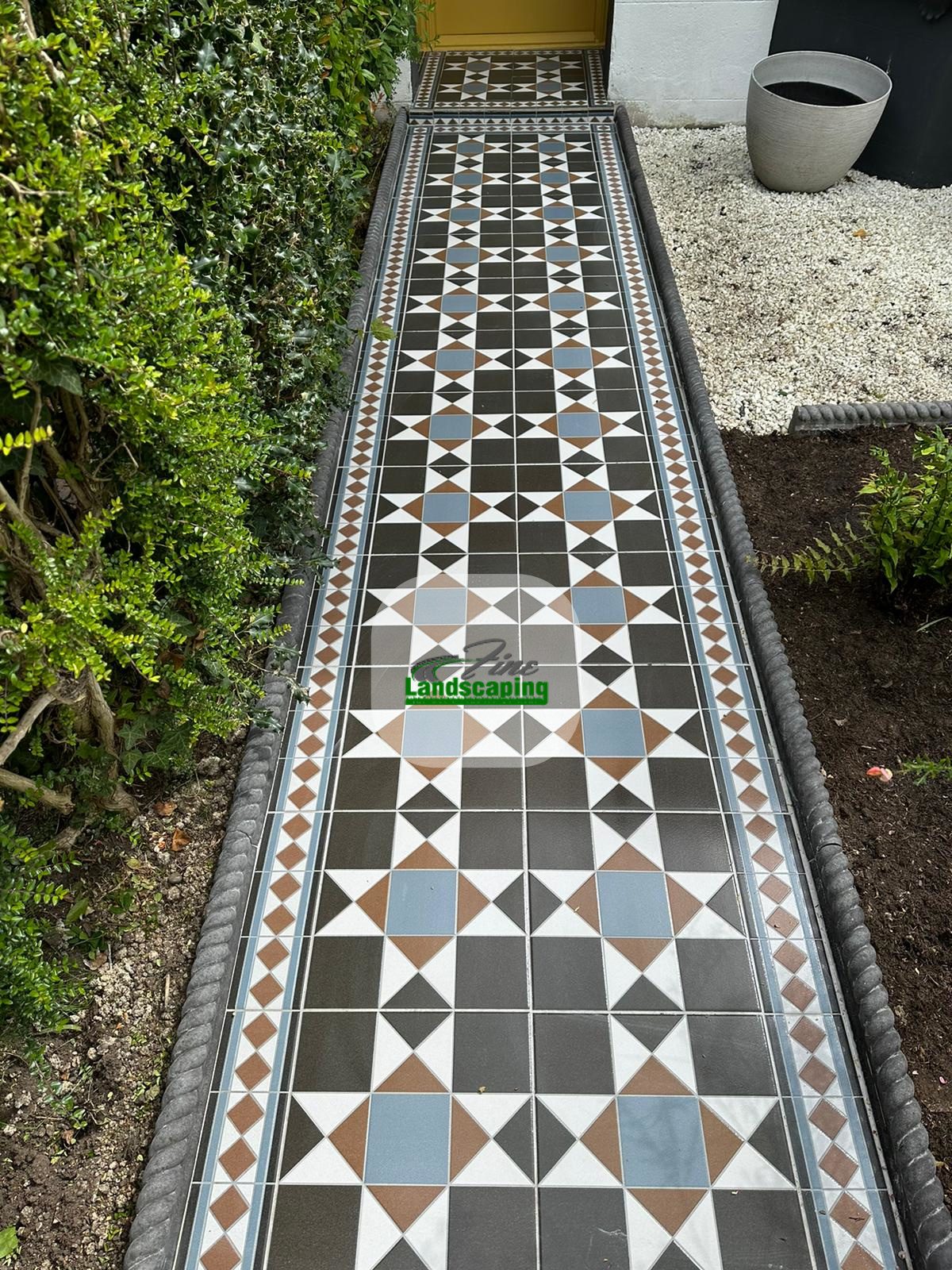
A Victorian tile path is made of small, thin geometric tiles, often in two or three colours, laid in a repeating pattern from the gate to the front door and often finished with rope-top edging. The pattern and colours are settled before any work starts: the Acton path follows the client's own design, and the Putney path is grey and white.
Because the tiles are so thin, they cannot bridge any movement underneath them, so the base matters more than anything on top. In Acton the old path was fully dug out, a new concrete base was cast with metal bars set into it, and only then were the tiles laid and the rope edging set along both sides. Laid that way, a path stays flat; laid on sand or old rubble, it soon shows every soft spot.
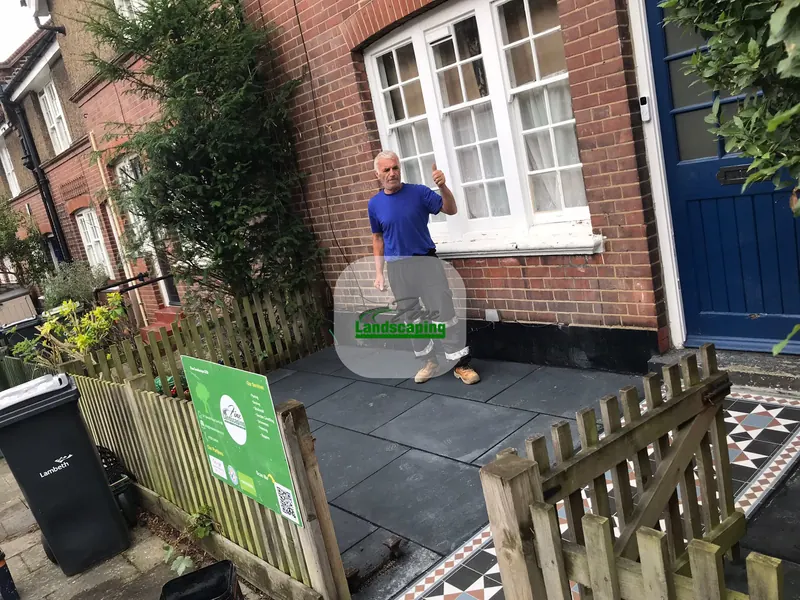
A tiled path rarely stands alone. It runs between a front wall and the front door, past a gate, beside paving or gravel, so it is planned with the rest of the front garden. In Putney a new red-brick wall with gate pillars and anthracite porcelain went in with the path, and in Clapham the path runs through black Brazilian slate. Every path is laid by our own team and covered by our 10-year workmanship guarantee.
We have three documented Victorian tile paths. The other jobs below are front gardens in other materials, which show how we build the rest of the front.
BeforeAfter
Front garden · drag to compare
BeforeAfter
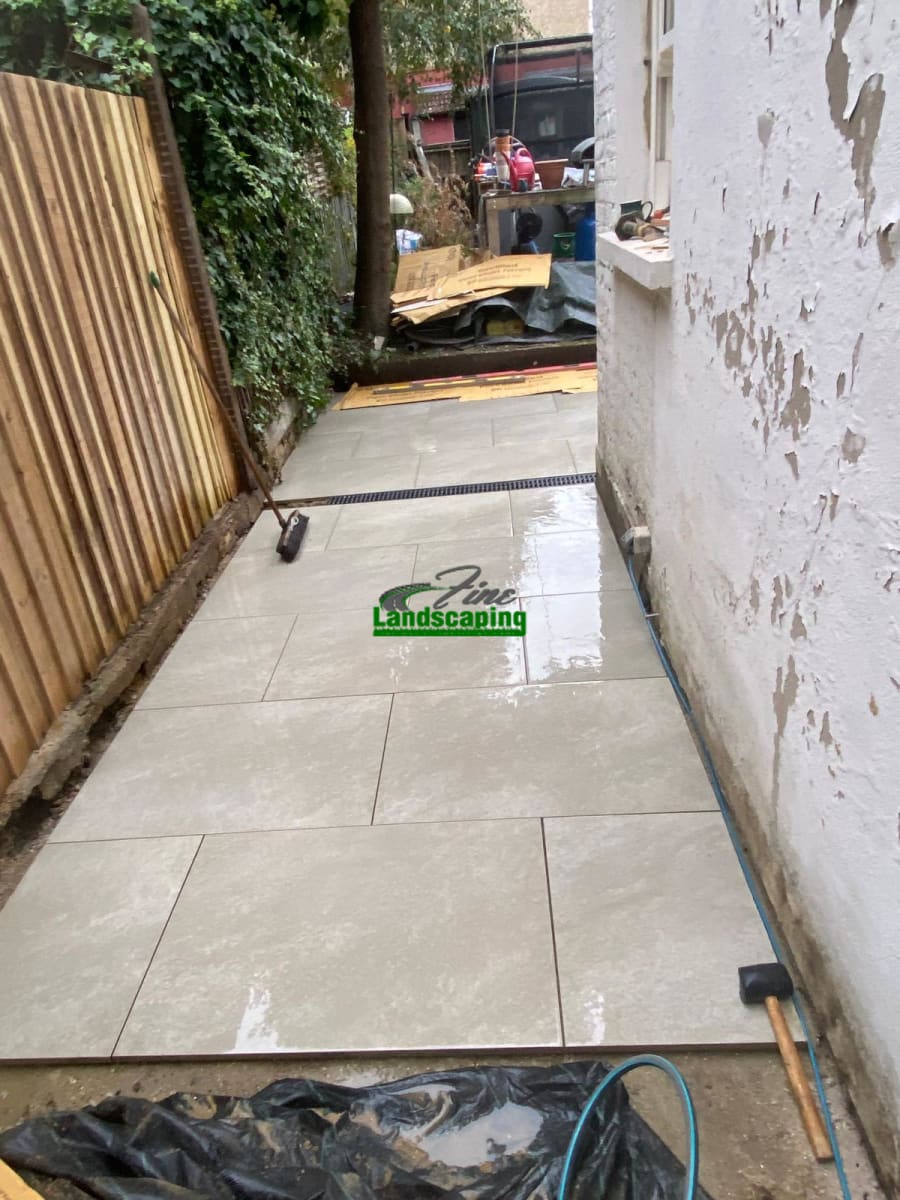
Side passage · drag to compare
BeforeAfter
Gate and path · drag to compare
Featured project · Putney SW15 · October 2025
Brick front wall, Victorian tile path and porcelain in Putney
This Putney house had a tired gravel front garden and a crumbling rendered front wall. The old wall and gravel came out, the front was dug out, and timber frames were set to the levels for the wall and the path. A new red-brick wall went up with pillars, around 15m² of anthracite porcelain was laid, and a grey-and-white Victorian tile path now runs from the gate to the front door, with the existing gate rehung between the new pillars. The side and back were redone in the same three weeks, for £22,000 including VAT.
A front and back garden transformation: two-level grey Indian sandstone, a sleeper retaining wall, steps, planters, eco drains, a Victorian tile path and black slate, in 2 weeks for £22,000 including VAT.
Plants and old sandstone removed from a front garden, a new base laid and the front finished in light grey porcelain, with the back sandstone patio cleaned and regrouted, in three days for £5,860 including VAT.
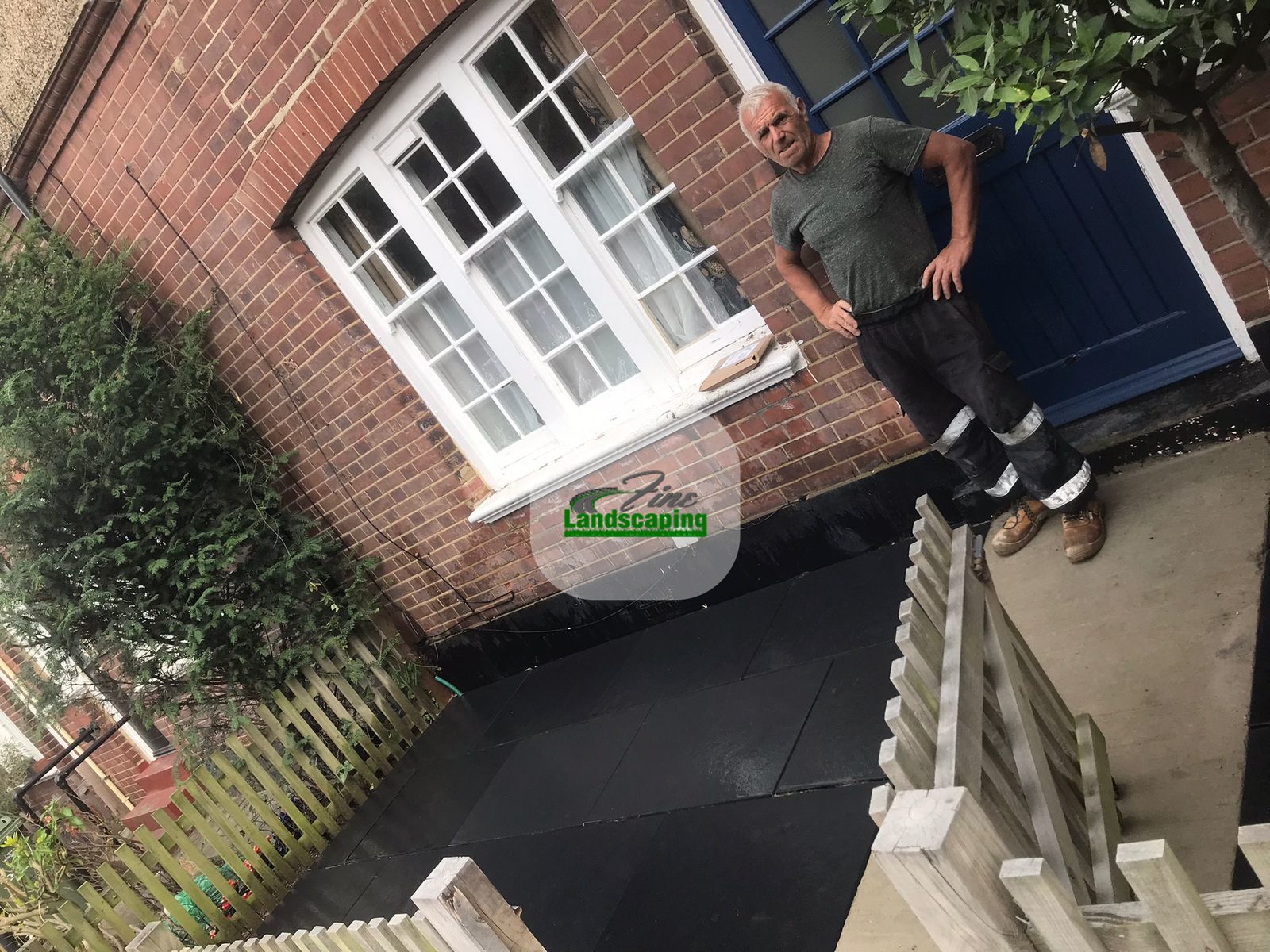
Photos of real tiled paths: the tiles and rope edging going down, finished paths seen from the gate and the pavement, and our team with the black slate laid beside the Clapham path. Click any photo to enlarge it; the place name opens that job's case study.
Every tile path we lay sits on a new concrete base with metal bars, as in Acton; the other choices are about how the path looks and how it fits the rest of the front. Each option has a real job to look at.
01
Pattern and colour
Chosen before we start
Geometric tiles come in many shapes and colours, and the pattern is fixed before the base is cast. The Acton path was laid to the client's own design; the Putney path is grey and white, running from the gate to the front door.
Rope-top edging along both sides frames the tiles and holds the edge of the path against the beds or paving beside it. The Acton path has it on both sides.
After a full dig-out, every tile path we lay gets a new concrete base with metal bars set in it, as on the Acton path. It is the part that decides whether the path stays flat.
The ground either side of the path can be paved to suit the house. In Clapham the tiles run through black Brazilian slate, in Putney beside anthracite porcelain, and in Balham a whole front garden was paved in black limestone.
A path usually starts at a wall and a gate. In Putney the old rendered wall was replaced by a new red-brick wall with pillars, the tile path was laid up to the door and the existing gate was rehung between the pillars.
Not every front suits tiles. Indian sandstone front gardens in Worcester Park and Furzedown and wall-to-wall porcelain in a Stockwell front garden show some of the alternatives.
A front path has fixed points at both ends: the pavement or gate at one end and the front door step at the other, often with a damp-proof course just above it. The tiles have to meet both neatly and still shed water away from the house. On the Putney job timber frames were set to the levels for the new wall and the path before anything was built, so the brickwork, the porcelain and the tile path all finish at heights planned in advance.
How we build it
How we lay a Victorian tile path
Four stages; on the Acton path the site work, from dig-out to finished tiles, took three days.
01
Survey and pattern
We measure the path, check the levels at the gate and the door step, and agree the tile pattern, colours and edging before sending a fixed written quote.
02
Dig out
The old path, gravel or concrete is fully dug out to the depth the new base needs, and the waste is taken away.
03
Concrete base
A new concrete base with metal bars set in it is cast, giving the thin tiles a rigid, even surface to sit on.
04
Tiles and edging
The tiles are laid to the agreed pattern, the edging is set, with rope edging on both sides in Acton, and the path is cleaned and handed over.
A complete quote, not a guess
How much does a Victorian tile path cost?
The one tile path we have priced on its own, in Acton, cost £3,820 including VAT for a full dig-out, a reinforced concrete base, the tiles and rope edging on both sides, in three days. The paths in Clapham and Putney were part of whole-house jobs at £22,000 each. The other jobs in the table, from £5,450 to £6,000, are front gardens in other materials, and some of those prices include fencing or other work: in Balham the front paving was £2,500 of the £6,000. Length, pattern, edging and what else changes at the front set the price.
How far the path runs from the gate to the door, and how wide it is.
Pattern
A simple two-colour design, or a more complex pattern with extra cutting.
Groundwork
Digging out the old path and casting the new base.
The rest of the front
Walls, pillars, gates and the paving or gravel beside the path.
Compare like for like. Check that each quote says what the tiles sit on, whether the old path is fully dug out, which edging is used and whether waste removal is included. Our written quotes list each part of the job separately.
Prices as shown on each case study. Every garden is different, so your price is fixed in a written quote after a free site survey.
7 local pages
Victorian tile paths by town
Each link below is a tiled path page for one town, grouped by council area and listed outwards from our Norbury base. The bold links are full local guides.
The tiled path in Acton, with a full dig-out, a reinforced concrete base, the tiles and rope edging on both sides, cost £3,820 including VAT and took three days. In Clapham and Putney the paths were part of whole front-and-back jobs, each £22,000 including VAT. A free survey gives a fixed written price for your path.
How do I pick a pattern for the path?
Start with the house. Simple chequerboard and border designs suit a modest terrace, while a larger house can carry a more elaborate geometric pattern, and original paths further along your street are a good guide. The Acton path followed the client's own design and the Putney path is grey and white; the layout is agreed before work starts.
What is the difference between a tiled path and porcelain paving?
Victorian tiles are small, thin and laid in a pattern, often with rope edging, which suits a period house; porcelain comes in large slabs such as 60x90 and gives a plain, modern surface. The two can share a front garden: in Putney a grey-and-white tile path runs beside around 15m² of anthracite 60x90 porcelain.
Do I need a new front wall as well?
Not always, but a new path often shows up the state of the wall beside it. In Putney the old rendered wall was breaking up, so a new red-brick wall and pillars went in with the path. A path can also be laid on its own, as it was in Acton.
Will my front gate need changing?
Not if it is sound. In Putney the existing gate was rehung between the new brick pillars at the head of the path. If a new gate is needed, we make gates in timber, sized to the opening, and fit them with the path.
Is a tile path a long job?
Not on its own: the Acton path, from dig-out to finished tiles and edging, took three days. As part of a whole front garden it fits within the bigger job, as in Clapham, where the tile path and black slate were done within a two-week project.
Do you lay tiled paths outside South London?
Our base is in Norbury SW16 and most of our work is in South London, but the Acton path in W3 shows we will travel for a tile path. The town pages below list the areas that have their own tiled path guides.
Is a tile path guaranteed?
Yes. Every path is laid by our own team, we are fully insured, and our workmanship carries a 10-year guarantee. The full terms are on our warranty and guarantees page.
Free site survey
Thinking about a tiled path?
Tell us roughly how long the path is, what is there now and whether the wall or gate needs work too. We will arrange a free site survey and send a written quote.