
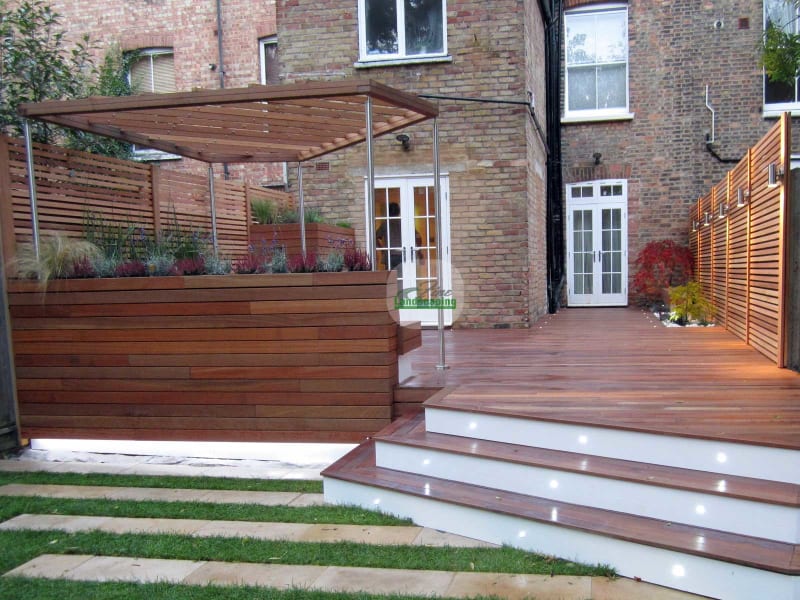
Spring 2026 has arrived in South London, and we're already seeing a surge in homeowners looking to transform their outdoor spaces. The question we hear most often at Fine Landscaping? "Should I choose composite or timber decking?"
It's a bigger decision than many people realise. We've installed hundreds of decks across Norbury, Croydon, Dulwich, and throughout Surrey over the years, and we've seen both materials perform brilliantly — and occasionally disappoint — depending on the circumstances.
This guide breaks down everything you need to know to make the right choice for your garden, your budget, and your lifestyle.
The Head-to-Head Comparison
| Criteria | Timber Decking | Composite Decking |
|---|---|---|
| Material Cost (per m²) | £60-90 | £120-180 |
| Installation Cost (per m²) | £40-60 | £50-70 |
| Total Installed Cost (per m²) | £100-150 | £170-250 |
| Lifespan | 10-15 years (treated softwood) 25+ years (hardwood) |
25-30 years |
| Annual Maintenance | Cleaning, sanding, oil/stain (4-6 hours) | Occasional washing (1-2 hours) |
| Slip Resistance | Good when dry, moderate when wet | Excellent (textured surface) |
| Colour Fade | Silvers naturally unless treated | Minimal over time |
| Warmth Underfoot | Stays cooler in hot weather | Can get hot in direct sun |
| Environmental Impact | Renewable (FSC-certified) | Made from recycled materials |
| Warranty | 1-5 years (material dependent) | 10-25 years (varies by brand) |
Timber Decking: The Traditional Choice
There's something timeless about real wood underfoot. Timber decking has been the go-to choice for British gardens for decades, and for good reason.
In South London and Surrey, we typically work with either pressure-treated softwood (usually pine) or hardwoods like Iroko, Cumaru, or Ipe. The choice between them dramatically affects both cost and performance.
Pros of Timber Decking
- Authentic appearance: Natural grain patterns and colour variation that composite can't fully replicate
- Lower initial cost: Particularly for softwood options, making larger projects more affordable
- Easy repairs: Individual boards can be replaced without specialist tools or matching discontinued lines
- Pleasant in heat: Doesn't absorb heat like composite, so barefoot walking is comfortable even in summer
- Traditional aesthetic: Perfect for period properties in areas like Dulwich, Beckenham, or Crystal Palace
- Renewable resource: FSC-certified timber is genuinely sustainable
Cons of Timber Decking
- Regular maintenance required: Annual cleaning and treatment to prevent rot, warping, and greying
- Shorter lifespan (softwood): Pressure-treated pine typically lasts 10-15 years in our climate
- Splinter risk: Particularly as boards age and weather
- Variable quality: Cheaper timber can warp, twist, or develop cracks within a few years
- Susceptible to moisture: Can develop mould or algae in shaded areas
A 20m² softwood deck in Croydon: £2,000-3,000 installed
A 20m² hardwood deck in Purley: £3,500-5,000 installed
(April 2026 pricing)
Timber Lifespan and Costs
Softwood decking with proper annual maintenance typically gives you 10-15 good years before boards need replacing. We've seen some well-maintained decks in Streatham and Norbury last even longer, but that requires religious upkeep.
Hardwoods are a different story entirely. An Ipe or Cumaru deck can easily last 25-30 years, but the initial outlay is substantially higher — sometimes double the cost of composite.
We always tell customers: if you're going timber, either budget for proper hardwood or accept that softwood is a 10-15 year investment. The middle ground rarely works out well.
Composite Decking: The Modern Alternative
Composite decking has evolved dramatically over the past decade. Early versions had a distinctly plastic appearance, but modern products are remarkably convincing — we've had clients in Bromley and Sutton who've had visitors genuinely unable to tell the difference.
Made from a blend of recycled wood fibres and plastic polymers, composite boards offer a fundamentally different proposition to timber.
Pros of Composite Decking
- Minimal maintenance: Just occasional cleaning with soapy water, no annual treatment
- Excellent longevity: 25-30 year lifespan is standard, with warranties to match
- No splintering: Safe for barefoot use throughout its life
- Colour stability: Minimal fading compared to timber
- Rot and insect proof: Won't decay, even in constantly damp areas
- Consistent quality: No knots, warping, or natural defects
- Slip-resistant: Textured surfaces perform well even when wet
Cons of Composite Decking
- Higher upfront cost: Nearly double the price of softwood timber
- Heat retention: Can become uncomfortably hot in direct summer sun
- Less authentic look: Despite improvements, close inspection reveals it's not real wood
- Expansion and contraction: Requires proper gap spacing during installation
- Potential for mould: Can still develop surface mould in shaded, damp conditions (though it washes off)
- Difficult repairs: Discontinued colours can make matching replacements impossible
A 20m² composite deck in Mitcham: £3,400-5,000 installed
Premium brands in Penge/Sydenham: £4,200-5,800 installed
(April 2026 pricing)
Composite Lifespan and Long-Term Value
Here's where composite starts to look more attractive financially. Yes, you're paying £170-250/m² installed versus £100-150/m² for softwood timber, but that timber needs treating every year.
A quality deck oil costs around £40-60 per tin, and you'll need 2-3 tins for a typical 20m² deck. Over 15 years, that's £1,200-2,700 in materials alone, not counting your time (or paying someone else to do it).
Composite's 25-30 year lifespan also means you're not facing a complete replacement when timber would need it. The total cost of ownership often works out very similar.
Which Should You Choose?
After installing both types across hundreds of gardens in South London and Surrey, we've found some clear patterns in who benefits most from each option.
Choose Timber Decking If You:
- Have a tighter budget for the initial installation
- Don't mind (or actually enjoy) annual maintenance work
- Want the authentic look and feel of natural wood
- Have a period property where composite would look out of place
- Are creating a temporary or 10-15 year solution
- Value the natural warmth of wood underfoot in summer
- Have significant tree coverage (timber stays cooler in shade)
Choose Composite Decking If You:
- Want a long-term, low-maintenance solution
- Value your time highly (no annual treatment needed)
- Have young children (no splinter risk)
- Plan to stay in your home long-term
- Have a modern property aesthetic
- Want consistent colour without regular treatment
- Have a deck in full sun exposure
A Real-World Scenario: The Norbury Garden Project
Last month, we completed two decking projects within half a mile of each other in Norbury. Both were similar-sized gardens (around 18m²), but the homeowners made opposite choices — and both were absolutely right for their situations.
The first client, a young family, chose composite decking at £4,320 installed. They have two children under five, limited free time, and plan to stay in the house for at least 15 years. The composite was perfect: no maintenance beyond occasional washing, no splinters, and it'll still look great when the kids are teenagers.
The second client, a semi-retired couple, went for premium hardwood (Cumaru) at £4,140 installed. They love gardening, don't mind the annual oiling (they actually find it quite satisfying), and adore the rich, natural colour variation. They also have a south-facing deck, where composite would get uncomfortably hot in summer.
Same budget, same size, completely different solutions — both absolutely delighted with the results.
Spring 2026: The Perfect Time to Install
If you're reading this in April or planning for May installation, you've picked the ideal window. Ground conditions across South London have dried out nicely after winter, making decking installation straightforward without the mud and mess of earlier months.
Spring installation also means you'll have your new deck ready for summer use, which is when gardens in areas like Crystal Palace, Beckenham, and Purley really come into their own.
We're currently booking projects for May and June, with lead times around 3-4 weeks from consultation to completion for standard-sized decks.
The Installation Process: What to Expect
Whether you choose timber or composite, the installation process is remarkably similar. The subframe is almost always timber (pressure-treated joists) for both options, with only the visible boards differing.
For a typical 20m² deck in somewhere like Streatham or Mitcham, expect the work to take 3-5 days including groundwork. We always ensure proper drainage beneath the deck — crucial in our South London clay soil — and set the frame perfectly level before any boards go down.
Composite takes slightly longer to install due to the need for precise gap spacing (expansion and contraction) and the density of the boards, which dulls cutting blades faster. That's reflected in the slightly higher labour costs.
The foundation makes or breaks a deck. We've repaired too many budget installations where corners were cut on the frame, and boards started sagging within two years. Whether you choose timber or composite, insist on proper groundwork.
Beyond the Deck: Complementary Features
Many of our clients in Bromley, Sutton, and surrounding areas combine their new deck with other garden improvements. A deck naturally leads to questions about the rest of the garden.
Popular combinations include artificial grass for low-maintenance lawn areas, garden walls for raised planting beds, or fencing to create privacy around the deck space.
If your deck will be in heavy use, consider adding proper drainage solutions to prevent water pooling beneath the boards — especially important in shadier spots where moisture lingers.
Ready to Transform Your Garden This Spring?
Whether you choose composite or timber, Fine Landscaping has over 15 years of experience installing decks across South London and Surrey. We'll help you make the right choice for your home, budget, and lifestyle.
Frequently Asked Questions
How much does composite decking cost compared to timber in London?
In April 2026, composite decking costs £170-250/m² installed in South London, compared to £100-150/m² for softwood timber. For a typical 20m² deck, that's £3,400-5,000 for composite versus £2,000-3,000 for timber. However, composite requires virtually no ongoing maintenance costs, whilst timber needs annual treatment costing £100-200 in materials plus labour or your time.
Which lasts longer, composite or timber decking?
Composite decking typically lasts 25-30 years with minimal maintenance, whilst pressure-treated softwood lasts 10-15 years with proper annual care. Hardwood timber like Ipe or Cumaru can match composite longevity at 25+ years but costs significantly more initially. The warranties reflect this: composite manufacturers offer 10-25 year guarantees, whilst timber warranties are usually 1-5 years.
Does composite decking get too hot in summer?
Yes, composite decking can become uncomfortably hot in direct summer sun — noticeably warmer than timber. This is particularly relevant for south-facing decks in full sun across South London. Lighter-coloured composite boards stay cooler than darker ones, and some premium brands now include heat-reflecting technology. If your deck gets full sun, timber may be more comfortable for barefoot use, or consider positioning furniture and shade solutions strategically.
How long does it take to install a deck?
A typical 20m² deck takes 3-5 days to install, including groundwork preparation, frame construction, and board installation. Composite decking takes slightly longer than timber due to more precise fitting requirements. Larger or more complex decks with multiple levels, integrated planters, or built-in seating can take 1-2 weeks. Spring 2026 has ideal weather conditions, making installation smoother than winter months when ground conditions can delay progress.
Do I need planning permission for a deck in South London?
Most domestic decks in South London don't require planning permission if they're below 30cm high and within your property boundary. Raised decks over 30cm may need permission, particularly if they overlook neighbouring properties. If you live in a conservation area (common in places like Dulwich or parts of Crystal Palace) or have a listed building, additional restrictions may apply. We always advise checking with your local council early in the planning process.